
Biological tissues are composed of heterogeneous populations of cells that may differ in their molecular characteristics, regulatory activity and functional states. Although cells within the same tissue generally share similar genetic information, they can exhibit substantial differences in gene expression, chromatin accessibility and epigenetic organization.
Traditional molecular biology approaches often rely on bulk measurements obtained from large populations of cells. While these methods provide valuable information about average molecular activity, they may conceal important differences between individual cells.
Single-cell technologies have transformed this perspective by enabling the analysis of gene expression and epigenetic features at the resolution of individual cells. Through the integration of single-cell RNA sequencing, chromatin accessibility profiling and other molecular approaches, researchers can investigate cellular diversity with unprecedented detail.
Combining transcriptomic and epigenomic information provides opportunities to understand how gene regulatory mechanisms contribute to cellular identity, differentiation and biological adaptation.
1. Understanding Cellular Heterogeneity
Cellular heterogeneity refers to the molecular and functional differences observed between cells within the same biological population.
These differences may arise from variations in transcriptional activity, epigenetic modifications, cell-cycle stages, environmental signals and developmental histories.
Even within apparently homogeneous tissues, individual cells can display distinct molecular signatures.
For example, immune cell populations may contain several functional subtypes characterized by different transcriptional programs. Similarly, stem cell populations can include cells at different stages of differentiation and developmental commitment.
Single-cell analysis allows researchers to identify these differences rather than interpreting a tissue exclusively through its average molecular profile.
Important sources of cellular heterogeneity include:
Differences in gene expression levels.
Variation in chromatin accessibility.
Cell-specific epigenetic modifications.
Distinct transcription factor activities.
Differences in cellular activation and differentiation states.
Responses to environmental and signaling conditions.
Characterizing these variations is essential for understanding how complex biological systems maintain their organization and respond to changing conditions.

2. Single-Cell RNA Sequencing and Gene Expression Analysis
Single-cell RNA sequencing (scRNA-seq) is a high-throughput technology used to investigate gene expression profiles at the individual-cell level.
Unlike conventional bulk RNA sequencing, which measures RNA abundance across a mixed cell population, scRNA-seq enables the identification of transcriptional differences between individual cells.
Most experimental workflows begin with the isolation or partitioning of individual cells, followed by RNA capture, reverse transcription, amplification and sequencing.
The resulting data provide information about the genes expressed in each cell and their relative abundance.

Major Experimental Approaches
Several platforms are used for single-cell transcriptomic analysis.
Droplet-based sequencing: Individual cells are encapsulated in droplets containing barcoded beads. Cellular transcripts are captured and associated with unique molecular identifiers and cell-specific barcodes.
Plate-based sequencing: Individual cells are deposited into separate wells, allowing detailed molecular analysis and, in some protocols, deeper transcript coverage.
Nucleus-based RNA sequencing: Single-nucleus RNA sequencing (snRNA-seq) analyzes RNA obtained from isolated nuclei. It is particularly useful for complex tissues and samples that are difficult to dissociate into intact cells.
Data Interpretation
scRNA-seq datasets generally contain thousands of cells and genes, producing large expression matrices.
Common analytical steps include:
Quality control and filtering of low-quality cells.
Normalization of gene expression measurements.
Identification of highly variable genes.
Dimensionality reduction using PCA and UMAP.
Clustering of cells according to transcriptional similarity.
Identification of cell-type-specific marker genes.
Differential expression analysis.
Functional enrichment and pathway analysis.
These procedures help distinguish cellular populations and identify transcriptional programs associated with specific biological states.
3. Single-Cell Epigenomic Profiling
Gene expression is influenced not only by the presence of transcriptional machinery but also by the regulatory organization of chromatin.
Epigenomic profiling investigates molecular features that influence genome accessibility and activity without changing the underlying DNA sequence.
At the single-cell level, epigenomic technologies allow researchers to characterize regulatory differences between individual cells.
Several complementary approaches have emerged.

Single-Cell ATAC Sequencing
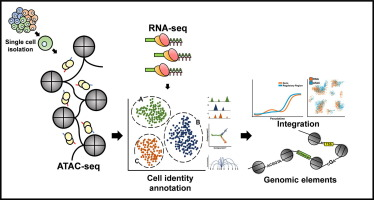
Single-cell ATAC-seq identifies regions of accessible chromatin across individual cells.
The method uses a hyperactive Tn5 transposase to insert sequencing adapters into accessible DNA regions. Sequencing subsequently reveals genomic locations that are more accessible to regulatory proteins and transcriptional machinery.
These regions may contain promoters, enhancers and other regulatory elements.
scATAC-seq is particularly useful for:
Identifying cell-specific accessible chromatin regions.
Characterizing regulatory elements.
Investigating transcription factor binding motifs.
Comparing chromatin states between cell populations.
Reconstructing potential gene regulatory relationships.

Single-Cell DNA Methylation Profiling
DNA methylation contributes to epigenetic regulation through the addition of methyl groups to cytosine residues, predominantly at CpG sites.
Single-cell methylation sequencing approaches investigate differences in methylation patterns between individual cells.
These technologies can reveal cell-specific epigenetic signatures and provide insights into developmental processes, cellular differentiation and gene regulation.
Single-Cell Histone Modification Analysis
Histone modifications influence chromatin structure and transcriptional activity.
Methods based on antibody-guided chromatin profiling, including single-cell adaptations of CUT&Tag and CUT&RUN, can investigate the distribution of selected histone modifications and chromatin-associated proteins.
These approaches help characterize active and repressive regulatory environments at higher cellular resolution.
4. Integrating Transcriptomic and Epigenomic Information
One of the major challenges in single-cell research is understanding how epigenetic regulatory mechanisms influence gene expression.
Transcriptomic data describe which genes are expressed, whereas epigenomic measurements provide information about the regulatory environment surrounding genomic regions.
Combining these datasets allows researchers to investigate relationships between chromatin organization and transcriptional activity.
For example, accessible chromatin regions located near a gene may indicate potential regulatory activity. When combined with RNA expression measurements, these regions can help identify candidate regulatory elements associated with gene activation.
Multi-omic approaches can also measure different molecular features from the same cell or nucleus.
Important strategies include:
Joint RNA and chromatin accessibility profiling.
Integration of DNA methylation and gene expression datasets.
Combined transcriptomic and histone modification analysis.
Linking enhancer accessibility with target gene expression.
Reconstruction of cell-specific gene regulatory networks.
Methods such as weighted nearest-neighbor analysis and other multimodal integration frameworks help identify relationships between different molecular measurements.
However, associations between accessible chromatin and gene expression do not necessarily establish direct regulatory causality. Additional experimental validation is often required.
5. Reconstructing Gene Regulatory Networks at Single-Cell Resolution
Gene regulatory networks describe the interactions between transcription factors, regulatory DNA elements and their target genes.
Single-cell technologies provide new opportunities to investigate these networks in specific cellular populations.
By combining gene expression measurements with chromatin accessibility data, researchers can identify potential regulatory relationships and examine how they differ between cell types.
For instance, a transcription factor may be expressed in several cell populations but show different regulatory activity depending on the accessibility of its binding sites.
Computational approaches can integrate transcription factor expression, motif enrichment, accessible chromatin regions and gene expression profiles to predict candidate regulatory interactions.
Common analytical approaches include:
Transcription factor motif enrichment.
Enhancer-to-gene association analysis.
Gene co-expression network reconstruction.
Regulatory activity scoring.
Cell-specific transcriptional network inference.
Pseudotime-based regulatory analysis.
These methods contribute to understanding how molecular networks coordinate cellular identity and biological responses.
6. Developmental Trajectories and Cellular Differentiation
Single-cell transcriptomic and epigenomic profiling can be used to investigate how cells transition between different biological states.
During differentiation, cells undergo coordinated changes in gene expression, chromatin accessibility and epigenetic organization.
Single-cell datasets can capture intermediate cellular states that are difficult to identify through conventional population-level experiments.
Pseudotime analysis is a computational approach that orders cells along an inferred developmental trajectory according to their molecular similarities.
It does not directly measure chronological time. Instead, it estimates relative progression through a biological process.
When combined with chromatin accessibility and transcriptional information, pseudotime analysis can help identify regulatory changes associated with cellular differentiation.
These approaches are particularly relevant to:
Stem cell differentiation.
Embryonic development.
Immune cell maturation.
Tissue regeneration.
Cellular reprogramming.
Developmental gene regulation.
7. Computational Challenges in Single-Cell Multi-Omics
The integration of single-cell datasets introduces several computational and statistical challenges.
Single-cell measurements frequently contain sparse data, technical variability and substantial differences in sequencing depth.
One important issue is the presence of dropout events, in which transcripts are not detected despite being present in the original cell.
Batch effects can also arise from differences in sample preparation, sequencing platforms, experimental conditions and laboratory procedures.
To address these limitations, computational workflows incorporate several analytical strategies.
Quality control: Removes low-quality cells, potential doublets and cells with abnormal molecular profiles.
Normalization: Adjusts for differences in sequencing depth and technical variability.
Batch correction: Reduces technical differences between samples while attempting to preserve genuine biological variation.
Dimensionality reduction: Projects high-dimensional molecular data into lower-dimensional representations for visualization and analysis.
Data integration: Combines multiple molecular modalities to identify shared cellular populations and complementary regulatory information.
Common tools and frameworks include Seurat, Scanpy, Signac, ArchR and scvi-tools.
The selection of an analytical method should reflect the characteristics of the dataset and the biological question being investigated.

8. Applications in Developmental Biology and Disease Research
Single-cell gene expression and epigenomic profiling have broad applications across biological research.
Developmental Biology
These approaches help identify molecular transitions during embryonic development and investigate how epigenetic mechanisms contribute to cell lineage specification.
Immunology
Single-cell profiling enables the characterization of immune cell populations, activation states and transcriptional responses to different stimuli.
Neuroscience
Single-cell transcriptomics and epigenomics can reveal molecular diversity among neuronal and glial populations and investigate gene regulatory mechanisms associated with cellular identity.
Cancer Research
Tumors frequently contain heterogeneous populations of malignant and non-malignant cells. Single-cell profiling can help characterize this diversity, investigate cellular states and identify molecular differences between tumor subpopulations.
Regenerative Biology
The analysis of stem cells and differentiating populations provides insights into the regulatory mechanisms involved in tissue maintenance and regeneration.
These applications demonstrate the importance of examining molecular activity at the level of individual cells rather than relying exclusively on averaged population measurements.
9. Emerging Technologies and Future Research Directions
The rapid development of single-cell technologies continues to expand the scope of molecular research.
Spatial transcriptomics introduces information about the location of gene expression within tissue architecture, helping preserve important spatial relationships between neighboring cells.
Single-cell multi-omics technologies are also becoming increasingly sophisticated, allowing researchers to investigate several molecular layers within the same cell.
Long-read sequencing, advanced chromatin profiling and improved computational frameworks are creating additional opportunities to study complex regulatory mechanisms.
Emerging research directions include:
Spatially resolved transcriptomic and epigenomic analysis.
Single-cell multi-omics integration.
Joint chromatin accessibility and transcription profiling.
Cell-specific DNA methylation mapping.
Advanced reconstruction of gene regulatory networks.
Machine learning for molecular data interpretation.
High-resolution analysis of cellular differentiation trajectories.
These innovations are moving biological research toward a more integrated understanding of cellular organization and molecular regulation.
Conclusion: From Cellular Heterogeneity to Integrated Molecular Understanding
Single-cell gene expression and epigenomic profiling have transformed the investigation of biological systems by revealing molecular differences that remain hidden in conventional bulk measurements.
The combination of transcriptomic, chromatin accessibility, DNA methylation and histone modification data provides a broader perspective on how cellular identity and function are regulated.
By integrating experimental technologies with computational analysis, researchers can investigate gene regulatory networks, characterize developmental trajectories and explore the molecular foundations of cellular heterogeneity.
As single-cell multi-omics continues to evolve, it will remain an important framework for understanding the relationships between genome organization, epigenetic regulation and biological complexity.